QUADRAT DTP: Frozen fieldwork: an archival analysis of Danish expeditions to the Greenland Ice Sheet in the 19th century
Fully funded, 42-month PhD project is part of the QUADRAT Doctoral Training Partnership. Open to UK and international applicants.
Supervisors: Dr Isabelle Gapp (Univ. of Aberdeen) & Dr Donal Mullan (Queen’s Univ. Belfast)
Location: University of Aberdeen, UK
Deadline: 17th January 2024
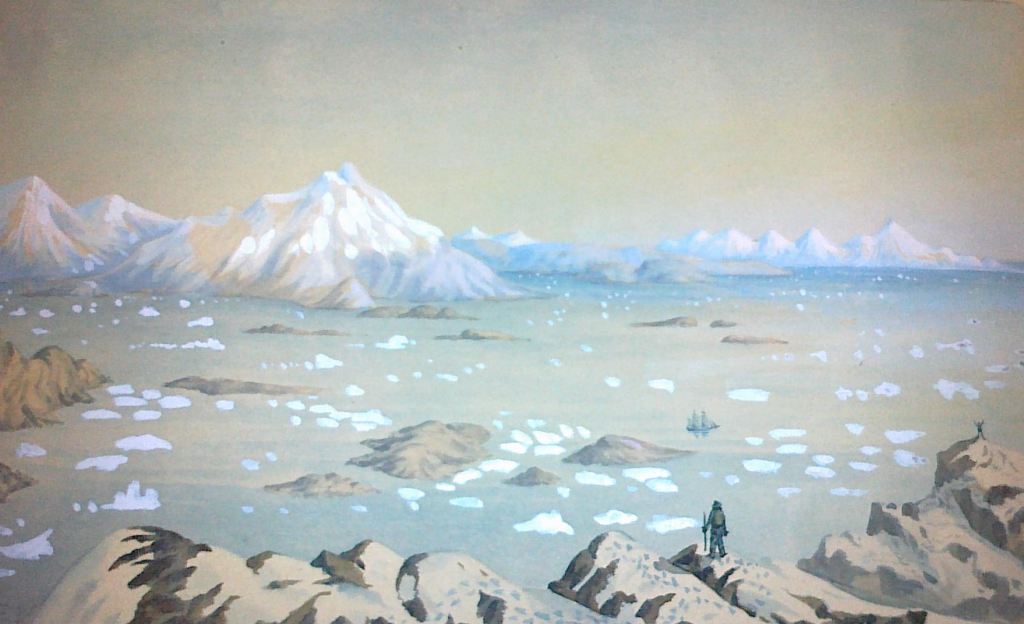
While photography has played a significant role in extending the glacial record pre-satellite observations, there remains much to be said about the role expeditionary field sketches pre-photography might play in understanding historic glacial change. This project will examine written and visual records from several significant expeditions which charted Greenland’s coastline and the Inland Ice in the 19th century for the purposes of developing an environmental proxy for extending the ‘observational’ record of the GrIS. The expeditions include, but aren’t limited to, those of Hinrich Johannes Rink (1819-1893), J.A.D. Jensen (1849-1936), and Carl Hartvig Ryder (1858-1923). Among these are hundreds of watercolour sketches and annotations noting iceberg formations and locations, crevasse measurements, the geology and biodiversity of nunataks, and coastal delineations of geological formations and outlet glaciers. Mostly held at the Danish Arctic Institute and National Museum of Denmark, these legacy field sketches have yet to be critically examined and their importance within both glaciology and art history assessed.
Twenty years ago, the glaciologist Peter G. Knight (2004) wrote that “The future of glacier science must be a future of collaboration.” This project takes up this call to action by pressuring the connection between art and science in the archives of these Danish expeditions and assessing the relevance of art history in reconstructing glacial history. The PhD student will carry out original research that engages geospatial and visual analysis to interpret archival records and how they might robustly be used to understand the historic dynamics, formations, and fluctuations of the GrIS.
Taking a historical approach to science is well established within the climate community, for example using diaries, ships logs, etc. However, within glaciology such sources have been somewhat overlooked and this project expands upon a recent ‘archival turn’ in glaciology (Curley et al 2021, Headland et al 2023) and interdisciplinary opportunities afforded within environmental art history (Gapp 2021). It also offers a unique opportunity to analyse unpublished materials aimed at studying and understanding the history of the GrIS at a time of heightened scientific interest. As the GrIS is increasingly responding to ongoing climate change, forcing the record of observed change is critical for understanding the ice sheet. The current observational record for the ice sheet (based on aerial photography) is robust only back to ~1900. To push this back further, which is extremely useful for contextualising subsequent change, we need to look to well constrained archival sources with expeditionary field sketches being one option. This project adopts an interdisciplinary framework for utilising archival records to better constrain and contextualise change from the 19th century. Such data sources can also be used to communicatepast, present, and future glacial environmental change.
Part of a larger interdisciplinary collaboration between the Department of Art History and the School of Geosciences at the University of Aberdeen, this project will combine geospatial analyses (e.g. calibrating the geometric robustness of paintings and sketches to allow meaningful estimates of ice margins, ice elevations etc) and archival research methods with an understanding of glaciological processes. The student will receive all necessary training through the supervisory team, with the expectation that they take ownership of the project as it progresses and direct it towards their developing specialist interests.
Candidate Background:
We invite applications from candidates of all backgrounds who have an interest in art history, glaciology, environmental history, the history of science, or cultural geography. They will also have a strong interest and demonstrable skills in one or more of the following: visual or object analysis, handling archival materials, museum collections, GIS, glaciology.
Given the interdisciplinary nature of this project, the student will have a genuine interest in working as part of an inter-departmental team and within a vibrant cryosphere group at Aberdeen, as well as alongside other QUADRAT students. International travel will form a large component of this project and so a desire to spend time abroad is highly advantageous. Proficiency in Danish or another Nordic language is beneficial, but not essential.
Candidates should have, or expect to achieve, a minimum of a 2.1 Honours degree (or equivalent) in a relevant subject. Applicants with a minimum of a 2.2 Honours degree may be considered providing they have a Distinction at Masters level.
We encourage applications from all backgrounds and communities, and are committed to having a diverse, inclusive team.
Informal enquiries are encouraged, please contact Dr Isabelle Gapp (isabelle.gapp@abdn.ac.uk)for further information.
 Isabelle Gapp
Leave a comment